DVIR requirements: 9 questions checked against the rule
A DVIR must identify the vehicle, list any defect found or reported, and be signed by the driver. The carrier then certifies repairs, the next driver signs, and the records are kept for three months. That is 49 CFR 396.11 and 396.13, which apply to commercial motor vehicles as defined in 390.5. We have not reviewed individual states. States that receive FMCSA safety funding must review their CMV safety rules for compatibility with the federal ones (49 CFR 350.303), so a vehicle used within one state can still be covered by state rules.
1. Do you need a DVIR every day?
Not under the federal rule. 396.11(a)(2)(i) says drivers "are not required to prepare a report if no defect or deficiency is discovered by or reported to the driver". FMCSA dropped no-defect reports for most carriers in 2014 and declined to bring them back in 2026. Your employer can still require a daily report.
2. Do passenger carriers still need no-defect reports?
A 2020 final rule rescinded them, effective September 17, 2020, and the regulation text no longer draws that distinction. FMCSA's guidance question 1 still said otherwise when we read it, so confirm with FMCSA if you carry passengers.
3. Is the pre-trip check the DVIR?
No. 392.7 and 396.13 cover what you do before driving. The written report under 396.11 is prepared "at the completion of each day's work". The post-trip guide compares them.
4. Must every listed defect be fixed before the next trip?
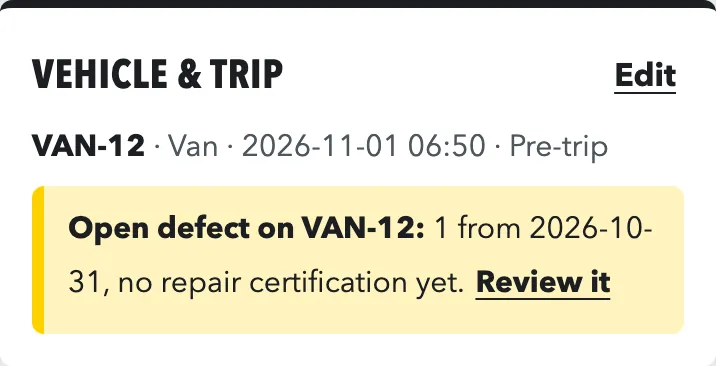
The repair duty in (a)(3)(i) covers defects "likely to affect the safety of operation". The certification in (a)(3)(ii) is wider: every listed defect needs a statement that it was repaired or that repair is unnecessary, before the vehicle is operated again. A defect can stay unrepaired only if the carrier certifies that repair is unnecessary.
5. Do both drivers have to sign?
Not in a two-driver operation. Under (a)(2)(ii), one signature is enough, "provided both drivers agree as to the defects or deficiencies identified".
6. Do the truck and trailer need separate reports?
FMCSA guidance says one report may be used for any combination, provided defects are identified for each vehicle and the driver signs. That is different from driving several vehicles in a day: (a)(2)(i) asks for a report on each vehicle operated, subject to the no-defect rule in question 1.
7. How long do you keep a DVIR?
Paragraph (a)(4) says three months from the date the report was prepared, covering the report, the repair certification and the driver's review. The one-year figure belongs to the separate vehicle maintenance records in 396.3(c).
8. Are one-truck operators exempt?
Paragraph (a)(5) says "the rules in this section" do not apply to a carrier operating only one commercial motor vehicle. That exempts them from 396.11 only. The text of 392.7(a) and 396.13 contains no matching exception, and 396.3 refers to every motor carrier. Because 396.13(b) refers to a report required by 396.11, our reading is that a one-truck operator mainly keeps the duty in 396.13(a) to be satisfied the vehicle is safe.
9. Can a DVIR be electronic? Is paper still allowed?
Yes to both, under the 2026 final rule. See electronic vs paper.
Recording the next driver's review
When the next driver opens a saved report on the same device in Roadmela, a review section lets them record their name and signature.
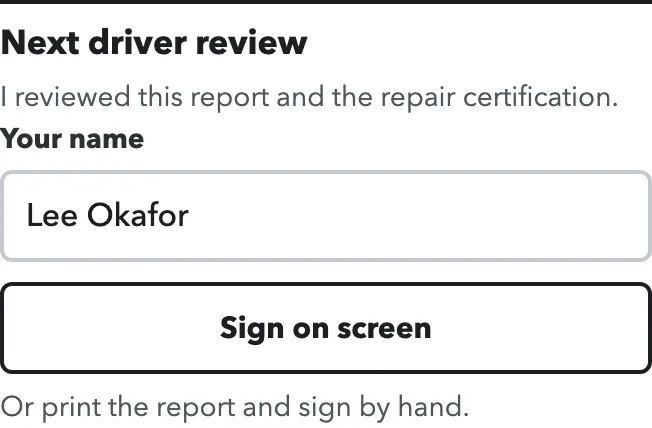
The DVIR form page shows each required part against its line on the form.
Keep reading
- Post-trip inspection: is it required by DOT, and what should it cover?
- Electronic DVIR vs paper: what the 2026 rule changed and which to use
- All guides
Sources
- 49 CFR 396.11, driver vehicle inspection reports
- 49 CFR 396.13, driver inspection
- 49 CFR 392.7, equipment, inspection and use
- 49 CFR 390.5, definitions
- 49 CFR 350.303, compatibility review: state responsibilities
- 49 CFR 396.3, inspection, repair and maintenance
- FMCSA final rule, 79 FR 75437, December 18, 2014
- FMCSA final rule, 85 FR 50787, August 18, 2020
- FMCSA final rule, 91 FR 7893, February 19, 2026
- FMCSA guidance, 396.11 question 1 (multi-day trips)
- FMCSA guidance, 396.11 question 5 (combinations)
Read 1 November 2026; eCFR text current to 29 October 2026. This is general information, not legal advice. Corrections: 1119224220zl@gmail.com.