DVIR form: free printable driver vehicle inspection report
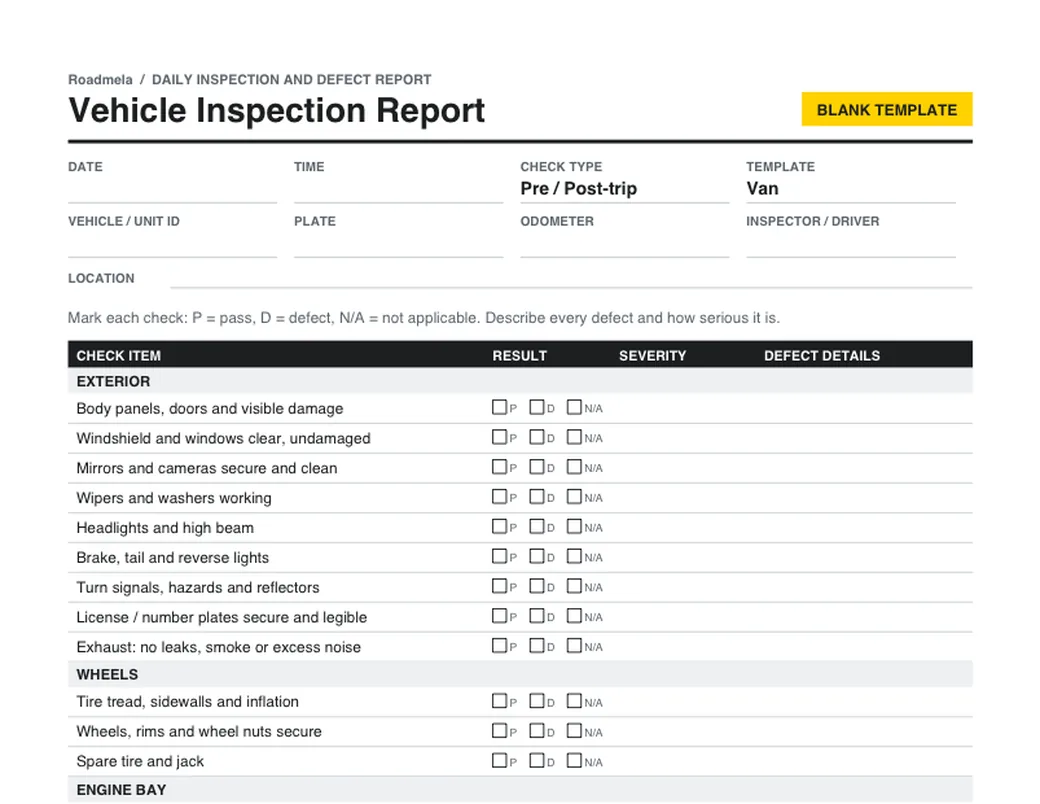
Download the form below. There is no email gate and no account. A DVIR identifies the vehicle, lists any defect, and carries the driver's signature, the repair certification and the next driver's signature. This form has a line for each. Its footer calls it a record aid: whether it serves as your required record is for your carrier to confirm.
| Vehicle | US Letter | A4 |
|---|---|---|
| Car / pickup 28 checks | Letter PDF | A4 PDF |
| Van 32 checks, adds the cargo area | Letter PDF | A4 PDF |
| Vehicle + trailer 37 checks, adds coupling, trailer brakes, lights and tires | Letter PDF | A4 PDF |
Prefer not to print? Fill in the same checklist on your phone: add photos, sign with a finger and share the PDF. It works without signal after one visit to the checklist page, and the records stay on your device.
How each required part maps to this form
49 CFR 396.11(a)(1) names 11 parts and accessories a report must cover at least. This is where each one sits.
| Part named in the rule | Paragraph | Check on this form |
|---|---|---|
| Service brakes, including trailer brake connections | (a)(1)(i) | Service brake pedal feel and travel; trailer form adds Trailer brakes and brake connections |
| Parking brake | (a)(1)(ii) | Parking brake holds |
| Steering mechanism | (a)(1)(iii) | Steering free play and power assist |
| Lighting devices and reflectors | (a)(1)(iv) | Headlights and high beam; Brake, tail and reverse lights; Turn signals, hazards and reflectors |
| Tires | (a)(1)(v) | Tire tread, sidewalls and inflation |
| Horn | (a)(1)(vi) | Horn |
| Windshield wipers | (a)(1)(vii) | Wipers and washers working |
| Rear vision mirrors | (a)(1)(viii) | Mirrors and cameras secure and clean |
| Coupling devices | (a)(1)(ix) | Trailer form only: Coupling locked; hitch pin and lock in place |
| Wheels and rims | (a)(1)(x) | Wheels, rims and wheel nuts secure |
| Emergency equipment | (a)(1)(xi) | Emergency kit: triangles, extinguisher, first aid |
The car and van forms have no coupling line, so use the trailer form whenever you tow. The forms also carry extra checks, such as fluids and seat belts, based on the UK DVSA van walkaround guide. Add your employer's own items in the notes box, or as custom checks if you fill it in on your phone.
What else the report has to do
| Requirement | Rule | On this form |
|---|---|---|
| Identify the vehicle, with one report per vehicle operated that day | 396.11(a)(2)(i) | Vehicle / unit ID and Plate at the top |
| List any defect that affects safety or could cause a breakdown | 396.11(a)(2)(i) | Defect details column, plus your own rating of whether it can be driven |
| Driver signs. In a two-driver operation one signature is enough if both agree on the defects | 396.11(a)(2)(ii) | Driver / inspector signature |
| Carrier certifies that listed defects were repaired or that repair is unnecessary, before the vehicle is used again | 396.11(a)(3)(ii) | Repair certification with both tick boxes |
| Next driver reviews the last report and signs that the repairs were certified | 396.13(b), (c) | Next driver review signature |
| Carrier keeps the report and both certifications for three months | 396.11(a)(4) | Your filing: keep the paper, or keep the PDFs and backups from the phone version |
| Report may be created and kept electronically, and signatures may be electronic | 396.11(a)(6); 390.32 | On-screen signatures in the phone version, subject to the conditions in 390.32; see electronic vs paper |
Who needs a DVIR
The federal rule applies to commercial motor vehicles in interstate commerce. Under 49 CFR 390.5 that means a vehicle or combination rated or weighing 10,001 lb or more, one designed or used to carry more than 8 people for pay or more than 15 unpaid, or one carrying placarded hazardous material. Three points to note:
- No defect, no written report. 396.11(a)(2)(i) says drivers need not prepare a report if no defect is found or reported. Your employer may still ask for one every day.
- One-vehicle carriers are exempt from 396.11. 396.11(a)(5) excludes any motor carrier operating only one commercial motor vehicle, private non-business passenger carriers and driveaway-towaway operations.
- The report is written at the end of the day's work. The pre-trip step in 396.13 is different: before driving, be satisfied that the vehicle is safe, review the last report if one was required, and sign it.
We have not reviewed individual states. States that receive FMCSA safety funding must review their CMV safety rules for compatibility with the federal ones (49 CFR 350.303), so a vehicle used within one state can still be covered by state rules.
This form does not make you compliant by itself. It is a record aid built for cars, pickups, vans and light towing. It was not designed for heavy trucks. Requirements depend on your vehicle, operation and state, so follow your carrier's procedure.
How to fill it in
- Walk around and tick P (pass), D (defect) or N/A for each check. Leave nothing blank, because a blank line reads as not checked.
- For each defect, write where it is and what you saw. Say whether the vehicle can be driven, and record who you reported it to.
- Sign. Hand it in with any defects, and keep a copy. A mechanic or manager completes the repair certification, and the next driver signs the review.
Related guides
- Nine DVIR questions, checked against the rule
- Whether a post-trip inspection is required
- Electronic DVIR vs paper, and what the 2026 rule changed
Sources
- 49 CFR 396.11, driver vehicle inspection reports
- 49 CFR 396.13, driver inspection
- 49 CFR 390.5, definitions
- 49 CFR 390.32, electronic documents and signatures
- 49 CFR 350.303, compatibility review: state responsibilities
- GOV.UK, carry out van daily walkaround checks
eCFR text current to 29 October 2026, read 1 November 2026. Published and updated 2026-11-01 by Roadmela. Corrections: 1119224220zl@gmail.com.