Pre-trip car inspection: a 28-point checklist for company cars and pickups
Check the outside, wheels, under the hood, the cabin and what you carry: the 28 checks are below, and you can print the form or open a filled-in example. For most cars and light pickups this is company policy rather than a federal requirement.
Do federal inspection rules apply to your vehicle?
The federal rules cover commercial motor vehicles. Under 49 CFR 390.5, a vehicle used in interstate commerce qualifies if its weight or weight rating is 10,001 lb or more. That test also counts the combination, so a pickup towing a trailer can cross the line even if the pickup alone does not. Passenger counts and placarded hazardous material are separate tests.
The GVWR is on the certification label, which 49 CFR 567.4 generally requires at the driver's door or door post. That section does not require a combination rating on the label, so if you tow, check the owner's manual or ask the maker. We have not reviewed individual states. States that receive FMCSA safety funding must review their CMV safety rules for compatibility with the federal ones (49 CFR 350.303), so a vehicle used within one state can still be covered by state rules.
If your vehicle falls outside the federal rule, your employer can still require checks. An older advisory guide from NETS, NHTSA and OSHA says "routinely inspecting company vehicles is an important part of preventing crashes and related losses". It says personal vehicles used for work are generally the owner's responsibility, but should still be kept safe.
The 28 checks
The notes are our suggestions, not rule text, and this is a look-and-listen check rather than a mechanic's inspection. Where the note is blank, the check name is the test.
| Section | Check | What to look for |
|---|---|---|
| Exterior | Body panels, doors and visible damage | New damage since the last check; doors that do not latch |
| Exterior | Windshield and windows | Cracks or chips, especially in your line of sight |
| Exterior | Mirrors and cameras | Secure, clean and not cracked |
| Exterior | Wipers and washers | Wipers clear the glass; washers spray |
| Exterior | Headlights and high beam | |
| Exterior | Brake, tail and reverse lights | Ask someone to look, or use a reflection |
| Exterior | Turn signals, hazards and reflectors | All corners flash; reflectors in place |
| Exterior | License / number plates secure and legible | |
| Exterior | Exhaust | No leaks, smoke or excess noise after starting |
| Wheels | Tire tread, sidewalls and inflation | See the tire numbers below; cuts or bulges in the sidewall |
| Wheels | Wheels, rims and wheel nuts | Nothing loose, missing or cracked |
| Wheels | Spare tire and jack | Present and usable; mark N/A if the vehicle has none |
| Engine bay | Engine oil level | |
| Engine bay | Coolant | Level in the reservoir, with the engine cold |
| Engine bay | Brake and power steering fluid | |
| Engine bay | Washer fluid level | |
| Engine bay | Leaks, belts and hoses | Drips under the vehicle; worn belts or hoses |
| Engine bay | Battery secure, not leaking | |
| Cabin | Dashboard warning lights | Lights that stay on after starting |
| Cabin | Service brake | Pedal feel and travel you would expect |
| Cabin | Parking brake holds | |
| Cabin | Steering | No unusual free play; power assist working |
| Cabin | Horn | |
| Cabin | Seats and seat belts | Seat locks in position; belts latch and retract |
| Cabin | Heater, defroster and demister | Clears the windshield |
| Equipment | Emergency kit | Triangles, extinguisher and first aid, if your vehicle carries them |
| Equipment | Registration and insurance documents | |
| Equipment | Previous report | You have read it, and any defect on it was dealt with |
The tire numbers
These come from NHTSA:
- Pressure: inflate to the vehicle maker's figure, which is on the door-frame label and in the owner's manual. The number on the tire is the maximum it can hold, not the recommended pressure.
- When to check: cold, meaning not driven for at least three hours.
- Tread: at least 2/32 of an inch on all tires. For the penny test, put a penny in the tread with Lincoln's head upside down. If you can see the top of his head, the tire needs replacing.
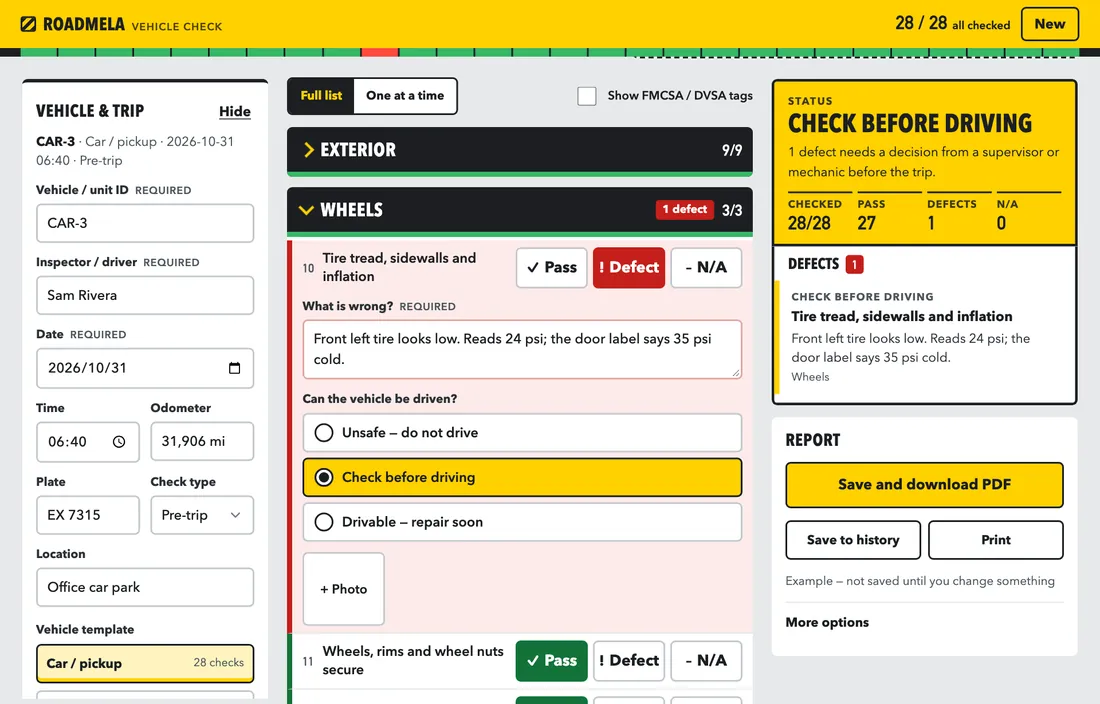
Example: a low tire
In the car example, which uses made-up details, a tire reads 24 psi against 35 psi on the door label, so the driver rates it "Check before driving". Roadmela records that rating. It does not decide whether a vehicle is roadworthy.
Keep reading
- Pre-trip inspection checklist: free PDF forms and how to use them
- Fleet vehicle inspection checklist: a simple system for small fleets
- All guides
Sources
- 49 CFR 390.5, definitions
- 49 CFR 567.4, vehicle certification label
- 49 CFR 350.303, compatibility review: state responsibilities
- NHTSA, winter driving tips (tire pressure and tread)
- NETS, NHTSA and OSHA, Guidelines for Employers to Reduce Motor Vehicle Crashes
Read 1 November 2026; eCFR text current to 29 October 2026. This is general information, not legal advice. Corrections: 1119224220zl@gmail.com.